Welcome to OptiCommPy’s documentation!
Note
This project is under active development.

Open-source simulation of fiber optic communication systems with Python
OptiCommPy is a Python framework to simulate fiber optic communication systems, from the bits at the transmitter to the performance metrics at the receiver. It brings together physical models of optical and optoelectronic devices, linear and nonlinear fiber propagation, optical amplification, receiver digital signal processing (DSP), forward error correction (FEC) and performance metrics, so that complete IM-DD and coherent optical links can be built and studied in a few lines of code.
It is designed for students learning optical communications, researchers prototyping and benchmarking new DSP algorithms or system concepts, and engineers who need a transparent, scriptable simulation environment.





Why OptiCommPy?
End-to-end simulation: transmitter, fiber channel, amplifiers, receiver front-end, DSP, FEC and metrics in a single package, with a consistent API.
Physically meaningful models: devices and channels are described by their physical parameters (Vπ, extinction ratio, responsivity, noise figure, fiber loss, dispersion, nonlinearity, laser linewidth, …).
Fast: performance-critical routines are compiled with Numba, and the most demanding ones (split-step fiber propagation, digital backpropagation, blind phase search) also run on NVIDIA GPUs via CuPy.
Transparent and hackable: plain NumPy/SciPy code that is easy to read, modify and extend, ideal for teaching and for prototyping new algorithms.
Peer reviewed and tested: published in the Journal of Open Source Software, with an automated test suite.
Features
Area |
What is included |
|---|---|
Modulation and sources |
M-PAM, OOK, square M-QAM, M-PSK and APSK constellations with Gray mapping; random bits, PRBS, CAZAC (Zadoff-Chu) sequences; probabilistic constellation shaping (Maxwell-Boltzmann); NRZ, RC and RRC pulse shaping; OFDM modulation and demodulation |
Transmitters |
WDM transmitter with multiple channels and polarization modes, optical PAM transmitter, laser model with phase noise and relative intensity noise (RIN), DAC with quantization and ENOB |
Optical and optoelectronic devices |
Phase modulator, Mach-Zehnder modulator (MZM), IQ modulator, polarization beam splitter, 90° optical hybrid, variable optical attenuator, PIN photodiode (shot and thermal noise, bandwidth limitation), balanced photodetector, single- and dual-polarization coherent receivers with IQ imbalance and skew, ADC with jitter, quantization and ENOB |
Fiber channel |
Linear fiber channel (loss and chromatic dispersion), nonlinear Schrödinger equation (NLSE) and Manakov models solved with the split-step Fourier method with adaptive step size, first-order perturbation models of nonlinear interference, AWGN channel |
Optical amplification |
Simple EDFA model (gain and ASE noise) and an advanced EDFA model solving the erbium rate and propagation equations |
Receiver DSP |
Resampling, matched filtering, Gardner clock recovery, chromatic dispersion compensation, N×N MIMO adaptive equalization (CMA, RDE, NLMS, DD-LMS, DA-RDE, RLS, DD-RLS), Manakov digital backpropagation, frequency offset estimation, carrier phase recovery (blind phase search, DD-PLL, Viterbi & Viterbi), sequence synchronization |
IM-DD DSP |
Feedforward (FFE), decision feedback (DFE) and Volterra equalizers, maximum likelihood sequence estimation (MLSE) |
Forward error correction |
LDPC encoding and decoding (sum-product and min-sum belief propagation, DVB-S2 codes, ALIST files) and Hamming codes |
Performance metrics |
BER, SER, SNR, Q-factor, EVM, mutual information (MI), generalized mutual information (GMI) and normalized GMI (NGMI), log-likelihood ratios, theoretical BER/MI/GMI curves, OSNR evolution in multi-span links |
Visualization |
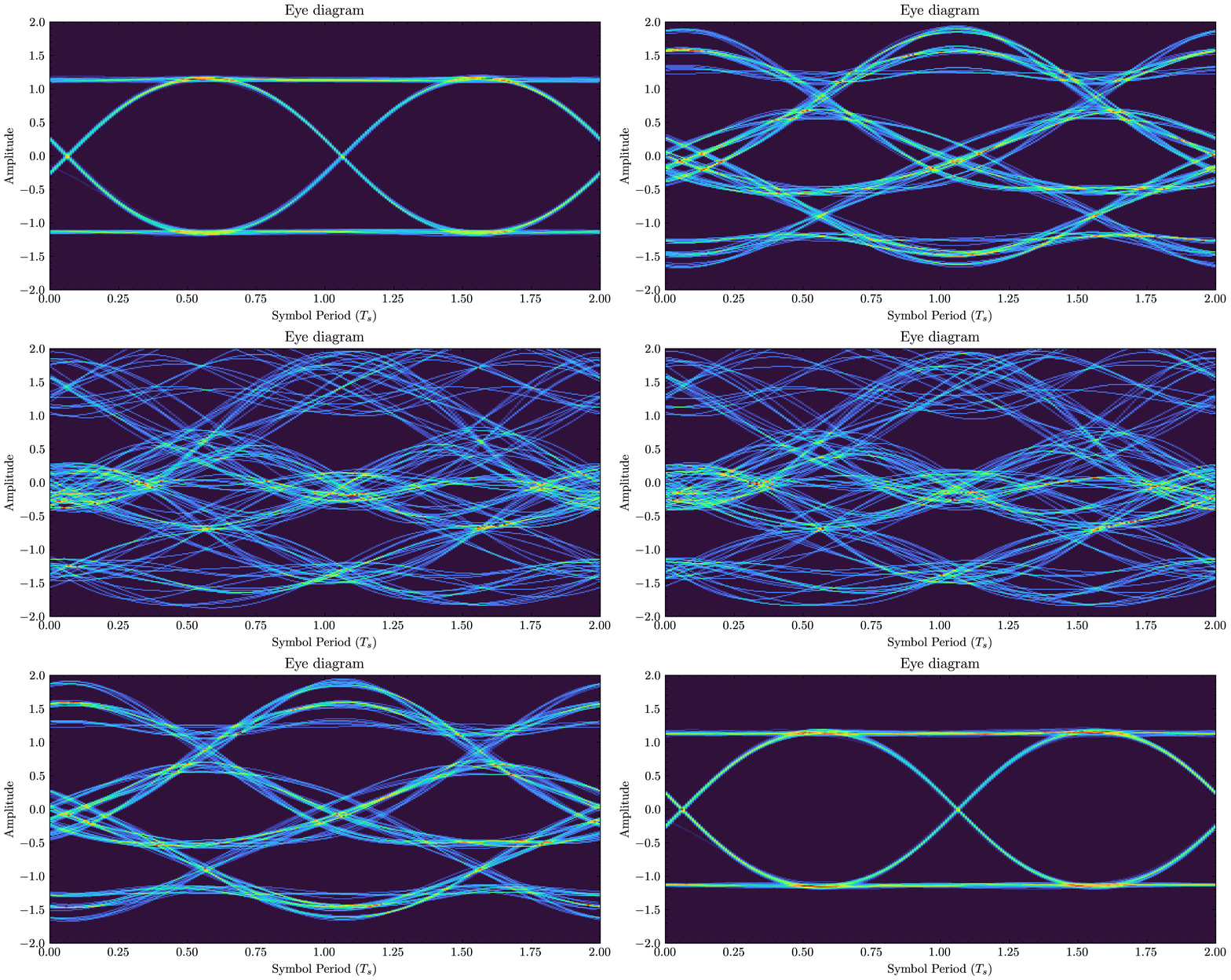
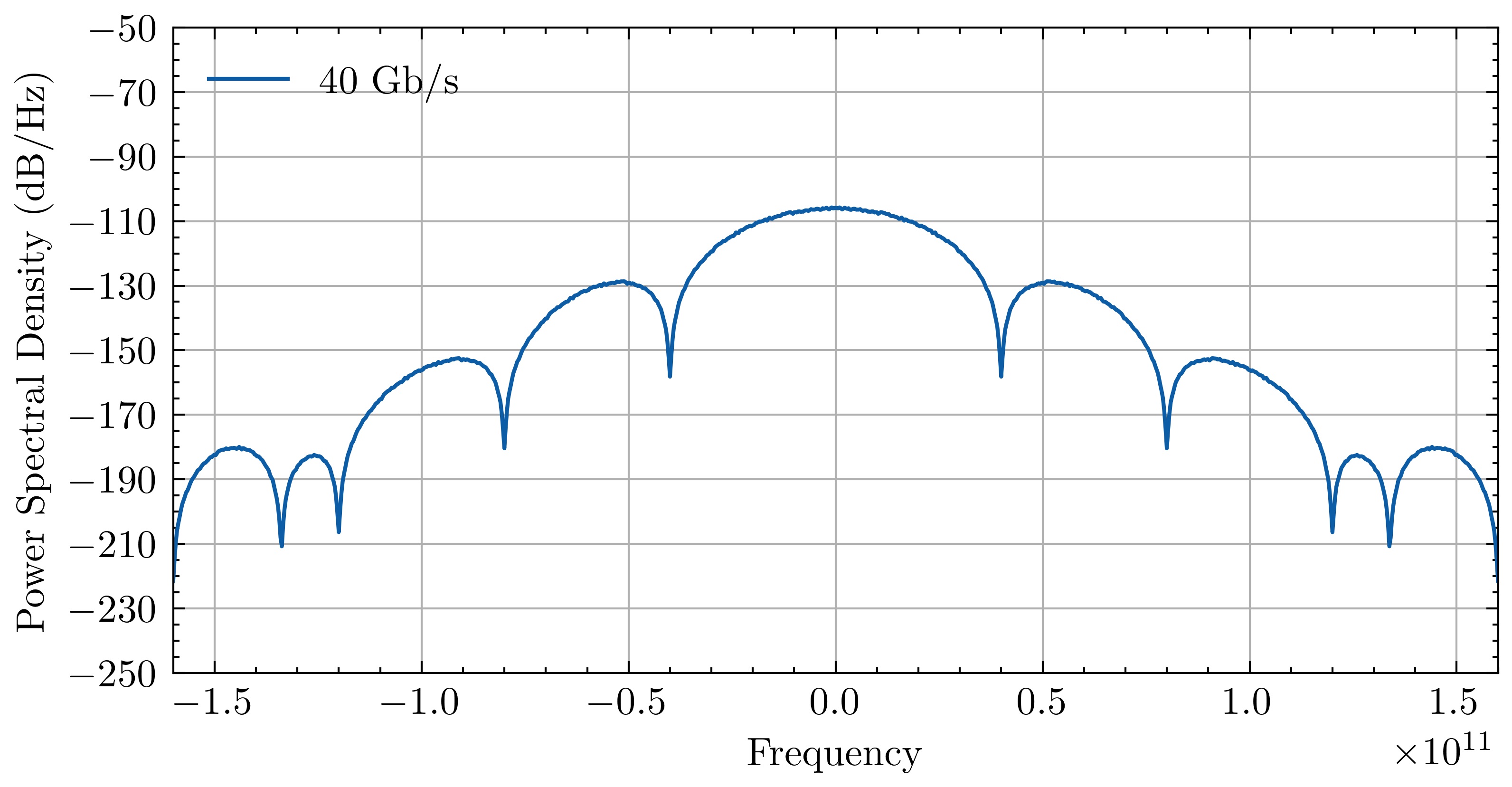
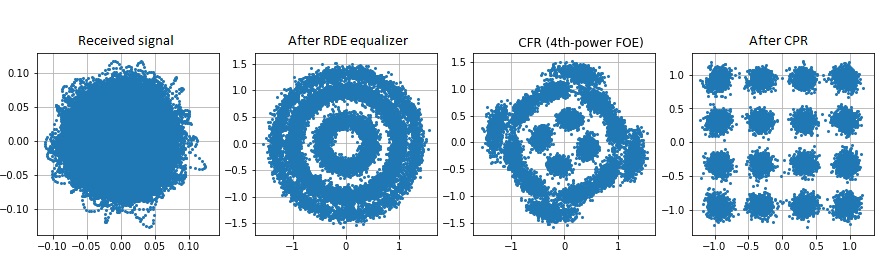
Density constellation plots, eye diagrams, power spectral density, decision boundaries, animated constellations |
Installation
OptiCommPy requires Python 3.10 or newer. Install the latest release from PyPI:
pip install OptiCommPy
or install the development version from GitHub:
git clone https://github.com/edsonportosilva/OptiCommPy.git
cd OptiCommPy
pip install .
GPU support (optional): to run the GPU implementations, install CuPy for your CUDA version, for example:
pip install cupy-cuda12x
Dependencies: numpy>=1.24.4, scipy>=1.13.0, matplotlib>=3.7.0, numba>=0.54.0, tqdm>=4.64.1, simple-pid>=1.0.1, mpl-scatter-density>=0.8, prettytable>=3.16.0, and optionally cupy-cuda12x>=13.1.0 for GPU processing.
Quick start
Simulate a 10 Gb/s NRZ-OOK transmission over 100 km of optical fiber with a direct-detection receiver, and measure its bit error rate:
import numpy as np
from optic.comm.sources import bitSource
from optic.comm.modulation import modulateGray
from optic.comm.metrics import bert
from optic.dsp.core import firFilter, pulseShape, upsample, anorm
from optic.models.devices import mzm, photodiode
from optic.models.channels import linearFiberChannel
from optic.utils import parameters, dBm2W

# 10 Gb/s NRZ-OOK over 100 km of fiber with direct detection
SpS, Rs = 16, 10e9  # samples per symbol, symbol rate
Fs = SpS * Rs       # sampling frequency

paramBits = parameters()
paramBits.nBits, paramBits.seed = 100_000, 123

paramPulse = parameters()
paramPulse.pulseType, paramPulse.SpS = "nrz", SpS

paramMZM = parameters()
paramMZM.Vpi, paramMZM.Vb = 2, -1

paramCh = parameters()
paramCh.L, paramCh.alpha, paramCh.D = 100, 0.2, 16  # km, dB/km, ps/nm/km
paramCh.Fc, paramCh.Fs = 193.1e12, Fs

paramPD = parameters()
paramPD.ideal, paramPD.B, paramPD.Fs, paramPD.seed = False, Rs, Fs, 456

# transmitter: bits -> 2-PAM symbols -> NRZ pulses -> MZM
bitsTx = bitSource(paramBits)
symbTx = modulateGray(bitsTx, 2, "pam")
sigTx = anorm(firFilter(pulseShape(paramPulse), upsample(symbTx, SpS)))
sigTxo = mzm(np.sqrt(dBm2W(3)), sigTx, paramMZM)  # 3 dBm laser

# fiber channel (loss + chromatic dispersion) and noisy photodiode
sigRx = photodiode(linearFiberChannel(sigTxo, paramCh), paramPD)

# BER and Q-factor from the samples at the center of each symbol
BER, Q = bert(sigRx[0::SpS])
print(f"BER = {BER:.2e}, Q-factor = {Q:.2f}")
The Getting started example in this documentation walks through this example step by step and extends it to BER versus received power curves.
Examples
The examples folder of the repository contains Jupyter notebooks covering the main features of the package. Most of them can be run directly in the browser with Google Colab, through the Open in Colab button at their top.
First steps: Getting started
IM-DD systems: Basic OOK transmission, PAM transmission, Equalizers for IM-DD, Photodiode model
Coherent WDM systems: WDM transmission, WDM transmission with amplification, Nonlinearity compensation with DBP, Perturbation models
Optical amplification: Basic EDFA, OOK transmission with advanced EDFA model
DSP: Core DSP functions, Clock recovery, Carrier phase recovery, Sequence synchronization
Communication theory: Modulation, Sources, OFDM, FEC, Metrics
GPU processing: GPU benchmark
Documentation
The full documentation, with the API reference of every module and rendered example notebooks, is available at opticommpy.readthedocs.io.
To build the documentation locally, install OptiCommPy with the documentation dependencies and run Sphinx from the root of the repository:
pip install .[docs]
sphinx-build -b html docs/source docs/build/html
Contributing
Contributions are welcome, from bug reports and documentation improvements to new models and algorithms.
Open an issue to report a bug or to discuss the feature you want to implement.
Fork the repository and create a new branch from the latest version of
main.Follow the conventions adopted in the code (naming, NumPy-style docstrings, etc.).
Add tests for your changes and make sure the test suite passes (
pip install pytest, thenpytest tests).Include an example of usage for new features, ideally as a notebook in the
examplesfolder.Open a pull request.
For suggestions or questions about OptiCommPy, get in touch by e-mail (edsonporto88@gmail.com).
Citing OptiCommPy
If you use OptiCommPy in your research, please cite the paper:
Edson Porto da Silva, Adolfo Fernandes Herbster. “OptiCommPy: Open-source Simulation of Fiber Optic Communications with Python”, Journal of Open Source Software, 9(98), 6600, (2024). https://doi.org/10.21105/joss.06600
@article{daSilva2024OptiCommPy,
  author  = {da Silva, Edson Porto and Herbster, Adolfo Fernandes},
  title   = {{OptiCommPy}: Open-source Simulation of Fiber Optic Communications with {Python}},
  journal = {Journal of Open Source Software},
  year    = {2024},
  volume  = {9},
  number  = {98},
  pages   = {6600},
  doi     = {10.21105/joss.06600}
}
License
OptiCommPy is distributed under the GNU General Public License v3.0.
Package documentation
- Digital Communications Utilities
- Digital Signal Processing (DSP)
- Core digital signal processing utilities (
optic.dsp.core) - DSP algorithms for adaptive filtering (
optic.dsp.adaptiveFiltering) - DSP algorithms for equalization (
optic.dsp.equalization) - DSP algorithms for carrier phase and frequency recovery (
optic.dsp.carrierRecovery) - Functions adapted to run with GPU (CuPy) processing (
optic.dsp.carrierRecoveryGPU) - DSP algorithms for clock and timming recovery (
optic.dsp.clockRecovery) - Signal synchronization functions (
optic.dsp.synchronization)
- Core digital signal processing utilities (
- Physical Models
- Models for optoelectronic devices (
optic.models.devices) - Models for fiber optic channels (
optic.models.channels) - Models for optical amplifiers (
optic.models.amplification) - Functions adapted to run with GPU (CuPy) processing (
optic.models.modelsGPU) - Advanced models for optical transmitters (
optic.models.tx) - Perturbation models for fiber nonlinear interference (
optic.models.perturbation)
- Models for optoelectronic devices (
- Plot Utilities
- General Utilities